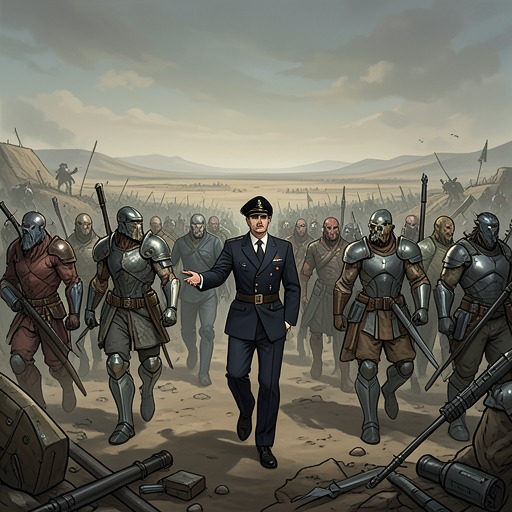
Cato kills Kosch with a particle beam
Systema Delenda EstCato’s particle-beam killing of Kosch is the moment when his orbital arsenal proves capable of destroying an Azoth, one of the highest-ranking champions of the System. The act is both a tactical triumph and an ethical rupture: Kosch’s shadow attack has already erased nearly a thousand-mile circle of living territory, and Cato responds by firing a weapon powerful enough to annihilate its target and devastate the surrounding region. The victory changes the military balance, but it leaves Cato confronting the scale of death produced by the war he has initiated.
Causes and Battlefield Conditions
Cato confronts Kosch during the Crusade called to stop his expansion through the System. Kosch dismisses Cato’s forces as insects and claims that the assembled armies contain no meaningful power. Cato begins targeting preparations but delays his strongest weapons because civilians remain nearby, despite his continuing efforts to evacuate the cities. His restraint also reflects a second practical limitation: the Mindrippers are still processing the mind-state extracted from the System Interface, consuming much of his available attention. Kosch removes the remaining uncertainty by attacking first. The Azoth spreads his arms, bares his teeth, and releases a wave of shadow that expands across miles in moments. It blankets half a continent in less than a minute, creating a perfect circle of lightless emptiness. A Platinum combatant escapes beneath the ocean, while another convoy pulls refugees underwater; even so, the darkness leaves no ordinary means of observing what is happening inside it, since the phenomenon absorbs light while allowing radio communication to pass through.
The Annihilation of the Target
When the shadow withdraws, it has erased everything within its radius except System buildings, cities, towns, and dungeon entrances. Living beings are gone: people, monsters, animals, trees, bushes, and grass have all been rendered absent, leaving bare rock and earth. Cato’s embodied frames react with sickness, and his digital memory makes the atrocity worse rather than easier, because he knows precisely how many men, women, and children have been killed. Leese is left nearly speechless, while Raine responds through the communications network with a grim-faced emoticon. Yaniss explains that this is why Azoths normally do not trouble frontier worlds: only War Worlds possess defenses capable of withstanding them. Cato answers that War Worlds are not the only exception; he is one as well. That declaration marks the transition from observing Kosch’s devastation to accepting the necessity of direct retaliation. Cato pulls the trigger on an orbital particle beam while the other combatants remain unable to answer the destruction they have witnessed.
The Particle Beam Weapon
The weapon is an immense orbital cylinder protected by layers of rock, ice, and metal beneath a vast halo of solar panels. Fractal heat radiators extend from its surface, and the phrase “To Whom It May Concern” is engraved in thirty-foot letters across its otherwise featureless exterior. Its designs originate in the closing phase of the No Fun Allowed War, although many of the engineering details remain beyond Cato’s own expertise. Thousands of square miles of solar arrays, supported by fusion generators, supply the energy required to operate it. The weapon accelerates ionized atoms through magnetic fields and directs them toward the planet at speeds approaching that of light. Its beam is nearly a foot thick and crosses almost fifty thousand miles in roughly a quarter of a second. In full framejack, Cato can observe the countdown while the beam itself remains effectively invisible, apart from energetic flashes where it intersects stray gas. When the stream reaches the atmosphere, it strips nitrogen and oxygen into ions, but Kosch receives less than a billionth of a second of warning. The beam is more than a conventional explosive discharge. Cato’s larger railguns already have yields comparable to nuclear weapons, but the particle beam is likened to standing continuously inside a nuclear detonation. Its destructive mechanism is neither ordinary heat nor impact. The particles collide with atomic structures, and their vast number produces an unending cascade that tears System matter apart. Kosch may possess resistance to heat, pressure, radiation, and plasma, yet he cannot deflect particles that pass through ordinary defenses and destroy his body simultaneously at the atomic level.
Kosch’s Death and Immediate Aftermath
Kosch’s body initially absorbs the beam for a moment or two, with defensive Skills preventing immediate devastation at the point of contact. Cato’s orbital surveillance network tracks him through the atmospheric disturbance, keeping additional particle beams ready in case he teleports or moves beyond coverage. The contingency is unnecessary. Kosch is not a System-god, and his durability has limits. He vanishes in a flash whose spectrum matches the constituents of carbon-based life, followed by a bloom of ravening fire where the beam strikes the ground. After a quarter of a second, the beam ceases. The capital city’s Nexus building remains, but everything else is scorched, broken rubble in a dissipating firestorm. Yaniss asks what has happened, and no one answers. Cato feels grim satisfaction at having destroyed the immediate threat, but that satisfaction is poisoned by the knowledge that many civilians have died because of a power-drunk System killer. His neural systems purge virtualized stress chemistry to prevent the memory from driving him into a darker psychological spiral, yet he still resolves that the next Azoth will not receive the benefit of the doubt.
Consequences and Narrative Significance
The killing establishes a new limit in the Crusade. Kosch’s attack demonstrates that a single Azoth can annihilate an enormous civilian population and landscape in seconds; Cato’s response demonstrates that orbital industry can kill such an enemy without allowing the enemy to reach or deflect the weapon. The confrontation therefore becomes a contest between System-granted divine durability and technology developed outside the System’s imposed restrictions. Cato’s victory does not make the war clean or controlled. It confirms instead that the conflict has entered a scale where defense, retaliation, and mass civilian death are inseparable. The event also sharpens the contrast between Cato’s stated opposition to the System and the behavior encouraged by the System itself. System quests make completion feel rewarding, and their objectives exert a reality-level pull that turns advancement into the path of least resistance. Kosch embodies the murderous logic of that structure: power is treated as proof of superiority, and entire populations become expendable obstacles. Cato rejects the System’s moral order, but his answer to Kosch reproduces its most frightening consequence—the willingness to destroy on a planetary scale when victory appears to require it. The later Crusade notifications deepen the significance of the scene. The System announces that Sunac and Enksa have been considered lost to Cato and purified, granting Muar essence for their destruction. Kosch’s death thus occurs within a reciprocal cycle of annihilation: Cato destroys an Azoth to halt an attack, while the Crusade converts the loss of worlds into reward and motivation. The same reward logic that makes killing feel pleasurable to System-ranked beings now turns the wider war into a self-reinforcing campaign. The remembered scale of Kosch’s attack also foreshadows the later catastrophe in which the entire Core catches fire. At that later moment, even the air becomes white-hot plasma across every surface in the Core, and the System’s essence reserves fall as higher-rank materials and individuals struggle to resist. Against that backdrop, the particle-beam killing of Kosch is not an isolated display of firepower. It is an early demonstration that the struggle between Cato and the System has become capable of converting inhabited worlds into wastelands, and that each victory carries the material and moral cost of the apocalypse it seeks to prevent.